

DevOps is not just a set of tools or a buzzword from the IT community. It is a fundamental approach to software development and operations that allows businesses to release products faster, more stably, and more cost-effectively. Put simply, DevOps is the bridge between developers and infrastructure. And if this bridge is poorly built, the company loses money literally every day.
In modern business, speed is a competitive advantage. Imagine two startups: one rolls out updates once a month, the other—every day. Who wins? It’s obvious. It is DevOps that allows for process automation, CI/CD implementation, infrastructure stability, and a reduction in the number of errors during releases. Research shows that companies with mature DevOps practices bring products to market faster and experience service outages less frequently.
But there is a catch: DevOps is expensive. It requires specialists with high levels of expertise, a complex technology stack (Kubernetes, Terraform, clouds), and constant support. This is where the key question arises: in-house DevOps vs. outsource—which model is truly more profitable?
How much a DevOps team costs in 2026
Average Salaries of DevOps Engineers
When a company starts calculating a budget, the first question that pops up is: what is the real devops team price and how to optimize these costs without losing quality. Let’s get straight to the numbers—without them, the conversation is meaningless. According to market data, DevOps remains one of the most expensive IT specializations. In Ukraine, the average salary of a DevOps engineer is about 60,000–65,000 UAH per month. But that is just the tip of the iceberg.
Looking deeper, the median salary for a DevOps specialist is around $4,200 per month, and in product companies, it can reach $5,000+. And that is just the salary. It doesn’t include taxes, bonuses, vacations, and other expenses.
Now imagine a minimum team:
- 1 Senior DevOps
- 1 Middle DevOps
- sometimes an SRE or Cloud Engineer
Total devops team price: $7,000–12,000 per month on salaries alone.
The Total Cost of In-house DevOps
But a business pays more than just a salary. The real cost of a DevOps team includes:
- taxes (up to 40% depending on the country)
- recruiting (HR, time, commissions)
- training and certifications
- downtime and onboarding
- equipment and licenses
In the end, the real devops team price easily grows 1.5–2 times. That is, instead of $10,000, the company actually spends $15,000–20,000 per month.
And that is still an optimistic scenario.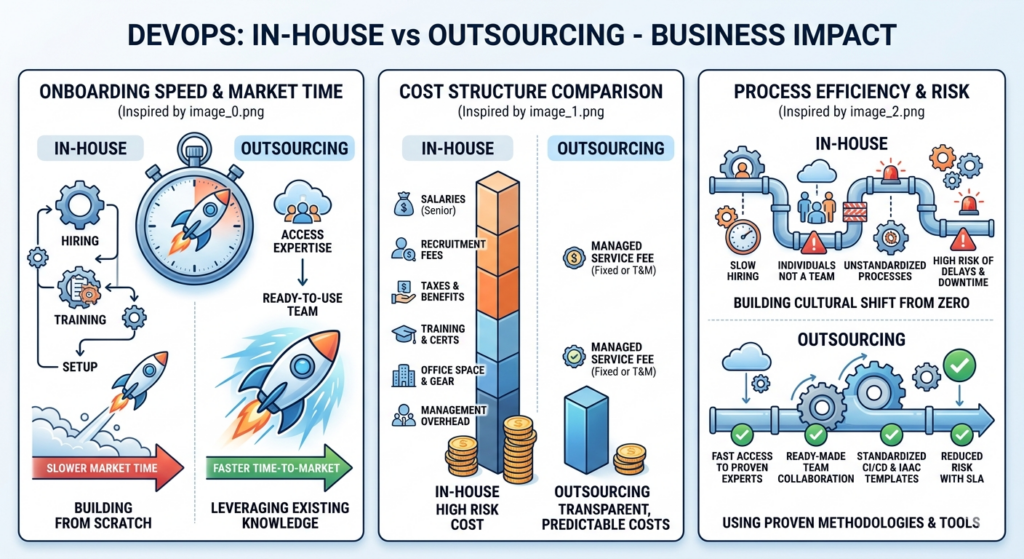
In-house DevOps Model: Pros and Cons
Advantages of an Internal Team
An internal DevOps team is like a personal car fleet. Everything is under control, everything is close by, and everything can be changed quickly. This is especially important for companies with high loads or unique infrastructure.
Main pros:
- full control over processes
- deep understanding of the product
- high team engagement
- data security
This model works perfectly in large companies where infrastructure is the core of the business. For example, fintech, banks, and SaaS platforms.
Disadvantages and Hidden Costs
But let’s be honest: in-house DevOps is expensive and difficult. Besides direct costs, there are hidden problems:
- hard to find top-tier specialists
- high turnover (DevOps change jobs easily)
- dependency on specific individuals
- long hiring process (2–4 months minimum)
And the most unpleasant part—the bottleneck. If you have only 1–2 DevOps engineers and one goes on vacation or resigns, the business risks being left without infrastructure support.
DevOps Outsourcing Model
How DevOps Outsource Works
DevOps outsourcing is when you buy the result rather than the people. You don’t need to hire, train, and retain specialists. You get a ready-made team with experience, processes, and tools.
It’s like renting a power plant instead of building your own. Yes, it’s not yours, but you receive electricity consistently.
Key Cooperation Formats
Several models exist:
- Dedicated team — a team dedicated specifically to your project
- Managed DevOps — full infrastructure outsourcing
- On-demand DevOps — pay-as-you-go/hourly rates
Each model suits different tasks, but the key idea is the same—flexibility and cost reduction.
In-house vs. Outsource DevOps: Direct Comparison
Cost
| Parameter | In-house | Outsource |
|---|---|---|
| Salaries | High | Included |
| Taxes | Yes | No |
| Recruiting | Yes | No |
| Total Cost | $15k–20k+ | $5k–12k |
The difference is obvious: outsourcing is 30–60% cheaper.
Flexibility and Scalability
An in-house team represents fixed costs. Even if the load drops, you pay the same amount.
Outsourcing offers flexibility. Need more resources? Scale up. Need fewer? Scale down.
Launch Speed
Building a DevOps team takes months. Outsourcing can be plugged in within 1–2 weeks.
This is where business begins to understand the real value of time.
DevOps Economics: Where the Real Benefit Lies
ROI from Outsourcing
Outsourcing provides savings beyond just salaries. The main benefits are:
- faster time-to-market
- reduced downtime
- fewer errors
- cloud cost optimization (FinOps)
For example, a skilled DevOps engineer can reduce cloud expenses by 20–40%. That’s thousands of dollars every month.
Savings Case Studies
A typical scenario:
- a company spends $15k on in-house
- switches to outsource for $8k
- saves an additional $3k on cloud costs
Result: savings of up to $10k per month.
When to choose In-house vs. Outsource
Scenarios for an In-house Team
In-house is justified if:
- you have a complex, unique infrastructure
- high security requirements
- constant 24/7 load
- large company (100+ employees)
Scenarios for Outsourcing
Outsourcing is the best choice if:
- you are a startup or SMB
- there is no internal expertise
- you need to launch quickly
- savings are a priority
How to Choose a DevOps Vendor
Key Criteria
Pay attention to:
- experience with your stack (AWS, Azure, Kubernetes)
- case studies and reviews
- SLA and guarantees
- process transparency
Common Business Mistakes
- choosing based on the lowest price
- absence of an SLA
- ignoring communication
DevOps is not just a service; it is a critical part of the business.
Conclusion
To put it bluntly, without illusions: DevOps outsourcing is more profitable in most cases. It is cheaper, faster, and more flexible. In-house only makes sense for large companies with specific requirements.
Key takeaway: a business doesn’t need a DevOps engineer; it needs a result—stable, fast, and cost-effective infrastructure.
And outsourcing delivers that result faster.