

Imagine a situation: an online store is generating stable profit, marketing campaigns are running like clockwork, and the development team is preparing to release new functionality. And suddenly — silence. The database is encrypted by ransomware, customers cannot pay for orders, and technical support is flooded with complaints. Losses amount to thousands of dollars for every hour of downtime. This is not a scene from a Hollywood movie, but the harsh reality for a business that ignores preventive security measures.
A high-quality server security audit is not just a formal checkbox in an IT department report. It is the foundation of your business stability, a guarantee of uptime, and a protection of your reputation. Regardless of whether you use dedicated physical servers, VPS, or are building a complex architecture in AWS and Microsoft Azure, regular security checks allow you to find vulnerabilities before malicious actors can exploit them.
In this article, we will break down in detail how a technical audit is conducted, which critical infrastructure nodes are subject to mandatory checks, and what budgets should be allocated for this task in the realities of the Ukrainian IT market.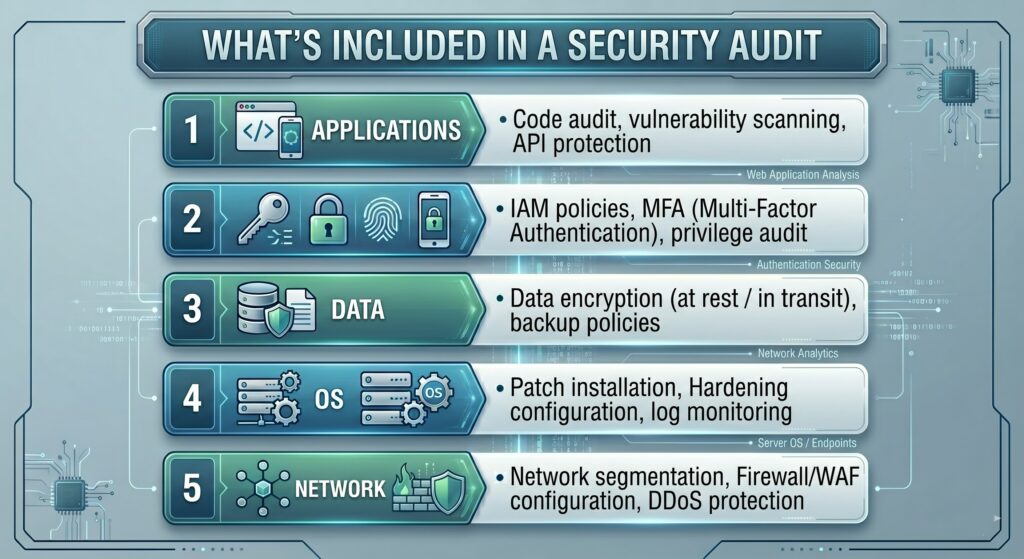
Why should CTOs and IT directors initiate an audit right now?
Many managers live under the illusion that their infrastructure is of no interest to anyone. “We are too small for a targeted attack” is a popular but fatal misconception. Modern cyberattacks are automated in 80% of cases. Scripts continuously scan the network in search of open ports, outdated versions of Ubuntu, or vulnerabilities in database configurations.
Here are three main reasons why a business needs an audit:
- Hidden vulnerabilities during scaling. When a startup grows quickly, the infrastructure is often put together “on the fly.” As migration to the cloud occurs or new microservices are added, gaps arise: forgotten test environments, open S3 buckets, excessive access rights (IAM).
- Financial risks and FinOps. Security is closely tied to costs. A compromised server can be used for hidden cryptocurrency mining or organizing DDoS attacks, which will lead to astronomical bills for cloud resource consumption (especially in AWS or GCP).
- Compliance and trust of enterprise clients. If you plan to work with European or American partners, compliance with standards (GDPR, PCI DSS, ISO 27001) will become a mandatory requirement. Without regular audits, it is impossible to get certified.
What does a deep server security audit include?
A full-fledged check is not limited to antivirus scanning. This is a multi-level process that affects all layers of your IT infrastructure — from network settings to application software.
1. Inventory and architecture analysis (Cloud & On-Premise)
You cannot protect what you don’t know about. An auditor begins by compiling an up-to-date network map. It often turns out that “shadow” servers or forgotten API gateways are running in the company.
- Network topology analysis.
- Assessment of environment isolation (separation of production, staging, and development).
- Checking routing and load balancing rules.
2. Network security and DDoS protection
At this stage, the perimeter is tested. The goal is to ensure that only what is strictly necessary for the application to function is accessible from the outside.
- Port scanning: Searching for non-standard or accidentally open ports (e.g., RDP or SSH exposed to the public).
- Firewall and WAF analysis: Checking the correctness of traffic filtering rule configurations.
- VPN and secure tunnels: Evaluating the cryptographic strength of protocols used for remote employee access.
3. OS and system software configuration assessment
The core of the audit is checking the operating systems themselves. Incorrect Linux or Windows Server configuration is the shortest path for a hacker.
- Patch Management: Checking if critical patches are installed. For example, using an outdated Ubuntu release instead of the current 24.04 LTS can leave the system without important kernel security patches.
- Hardening: Disabling unused services, configuring secure password storage, restricting superuser privileges.
- Log analysis and monitoring: Is there remote system log forwarding (SIEM) configured to prevent log tampering in case of a hack?
4. Access management and authentication (IAM)
The human factor remains the weakest link. Auditors check how access to critical nodes is implemented.
- Mandatory use of multi-factor authentication (MFA) for all administrative accounts.
- Principle of Least Privilege: developers should not have root access to production databases without absolute necessity.
- Password policy audit: banning the use of default credentials.
5. Database security (SQL Server, PostgreSQL, MySQL)
Databases are the primary target of any attack, as they contain commercial secrets and personal data.
- Checking SQL Server configuration (disabling weak encryption protocols, auditing
saaccount permissions). - Assessing backup policies. Backups must be encrypted and stored isolated from the main server so they don’t become victims of ransomware.
- SQL injection protection at the DBMS configuration level.
Specifics of auditing for cloud infrastructures
When moving to the cloud, the rules of the game change. The Shared Responsibility Model means that the provider (AWS, Azure) protects the physical hardware and the base network, but you alone are responsible for how you configured your virtual machines, containers, and data storage.
In cloud environments, the focus shifts to:
- IAM policy control: Misconfigured roles are the cause of most leaks in AWS.
- Serverless and container protection: Scanning Docker images for vulnerabilities before deployment, analyzing Kubernetes manifests.
- Data encryption (Data at Rest / Data in Transit): Ensuring that EBS disks or Blob Storage are encrypted with your own keys (KMS).
Practical case: Migrating an online store from VPS to AWS — a guarantee of 99.9% uptime. As part of a project for a large e-commerce platform, we conducted a comprehensive audit before migration. The original VPS architecture had a single point of failure and direct access to the database from the internet. A preliminary security check allowed us to design a new fault-tolerant architecture in AWS. We implemented a WAF, distributed resources across different Availability Zones, and set up a private subnet for the databases. The result: a successful move, zero downtime during attacks, and stable 99.9% uptime, which is critically important during sales seasons.
Audit stages: from brief to report
A high-quality audit is not done in a single day. It is a structured project that goes through several key stages:
- Scoping and data collection: Defining the audit boundaries. What exactly are we testing? The entire infrastructure or just the billing cluster? Signing an NDA.
- Automated scanning (Vulnerability Assessment): Using specialized software (Nessus, OpenVAS, Qualys) to quickly search for known CVEs (Common Vulnerabilities and Exposures).
- Manual analysis: An expert analyzes the architecture, deployment automation scripts (Terraform, Ansible), checks business logic and configurations that a scanner cannot see.
- Exploitation attempt (optional – Penetration Testing): “White hat” hackers try to breach the system using discovered vulnerabilities to prove the reality of the threat.
- Report formation: The most important stage for an IT director. You receive not just a sheet of text from a scanner, but a prioritized list of issues (Critical, High, Medium, Low) with specific instructions for fixing them (Remediation Plan).
How much does a server security audit cost in Ukraine?
The price depends on many factors: infrastructure size, technologies used (on-premise, cloud, hybrid), the need for penetration testing, and standards for which the check is performed.
To provide market context, we have compiled an estimated cost table:
| Package / Audit Type | Description and Scope of Work | Estimated Cost | Suitable For |
| Basic (Vulnerability Scan) | Automated scanning (up to 15-20 IPs), search for known vulnerabilities (CVEs), checking closed ports and SSL certificates. Basic report without deep manual analysis. | $200 – $600 | Small projects, landing pages, simple web applications on a single VPS server. |
| Comprehensive Audit (Standard) | Automated + manual testing. Architecture audit, OS (Linux/Windows) and database configuration analysis. Checking password and access policies. Report with remediation recommendations. | $900 – $2,500 | Medium business, online stores, corporate portals (including 1C / BAS servers), SaaS projects. |
| Cloud & Enterprise + PenTest (Advanced) | Deep cloud environment analysis (AWS/Azure/GCP), IAM policy audit, container security (Kubernetes/Docker). Includes simulated real-world hacker attacks (penetration testing). | from $4,000 | Fintech, MedTech, large e-commerce, IT companies, businesses with strict compliance requirements (PCI DSS, GDPR). |
It is important to understand: saving on an audit often results in colossal costs for incident remediation.
Internal audit vs External experts
Many technical leads wonder: “We have strong DevOps engineers, why should we pay external auditors?”.
The problem with an internal audit lies in the “blind spot” effect. A system administrator who has spent years building the architecture subconsciously trusts their own solutions. They might ignore a potentially dangerous script combination simply because “it has always worked this way and there were no problems.”
An external security check provides an independent, unbiased perspective. Audit experts encounter dozens of different breaches daily and possess up-to-date knowledge about new attack vectors. The ideal synergy is when internal DevOps teams work in tandem with external auditors, jointly implementing SecOps best practices.
FAQ: Common questions about the audit
How often should server checks be performed? Ideally, once a year for stable projects. However, if you are rolling out major architectural changes (e.g., migrating Microsoft Exchange servers or moving servers to the cloud), the audit should be conducted before and after the migration.
Will the audit affect server operation and site availability? A professional audit is planned to avoid disrupting business processes. Scanning and tests are conducted during off-peak hours or on staging environments (copies of production servers).
Can security checks be automated? Partially, yes. Implementing DevSecOps practices allows for automated code and container scanning during every deployment. But this does not replace periodic manual architecture audits by an expert.
What to do after receiving the audit report? The report is a roadmap for action. It is necessary to draw up a plan for remediating vulnerabilities, starting with the critical ones (Critical/High). Audit companies often offer services for supporting the remediation process (Remediation support).
Conclusion
Modern business infrastructure is a complex, living organism. Outdated software, configuration errors, or forgotten access rights can destroy what has been built over years in an instant. A regular server security audit is an investment in your business resilience, downtime risk reduction, and protection of customer trust.
Do not wait for malicious actors to find a vulnerability. Assess the real state of your IT infrastructure today.
Ready to ensure your servers are securely protected? Contact us for a free initial consultation. We will discuss your project’s architecture, select the optimal audit format, and help build ironclad protection for your business.